Provided by KTX Cattleman Capital, in conjunction with Trading Spaces. Commentary for entertainment only. Not financial advice.
Executive Brief · 26-11-18 07:00 CT
Who Paid for the Yen Rescue? The Receipts Are In
Opinion and commentary from KTX.
Data as of 26-11-18 05:35 CT (FX rate through 26-11-13; TIC through 26-08)
Who paid for the yen rescue?
In late July the dollar climbed to a multi-decade high near 164 yen (New York Fed, 26-11-12). On 26-07-30 and 26-07-31, Tokyo and Washington stepped in. This month both governments published the receipts. Here is what they show, and why a currency story is also a bond story.
The receipts
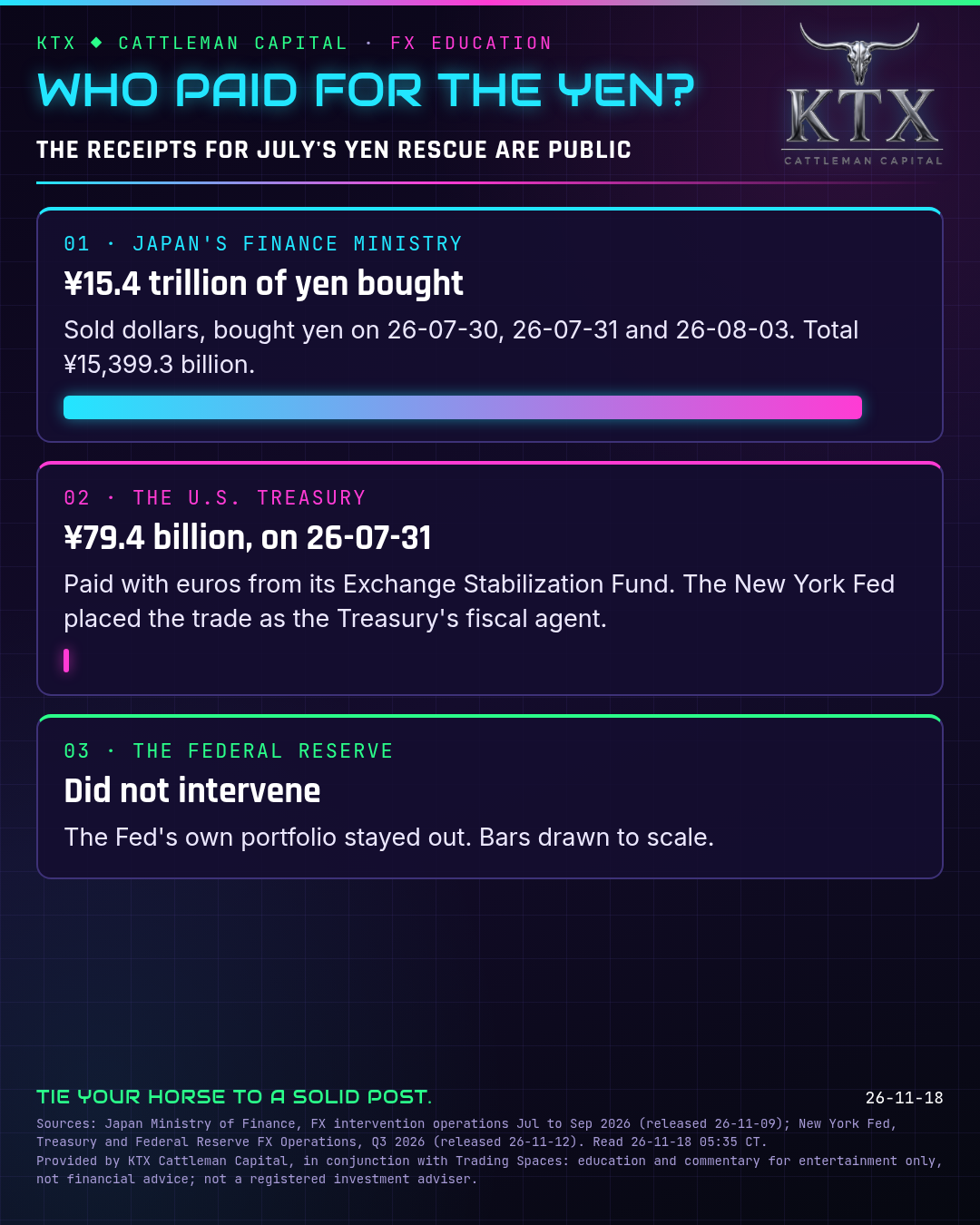
Japan’s Ministry of Finance bought yen on three days: ¥7,975.6 billion on 26-07-30, ¥5,552.3 billion on 26-07-31 and ¥1,871.4 billion on 26-08-03. The July to September total was ¥15,399.3 billion, about ¥15.4 trillion, all against the U.S. dollar (Japan MOF, 26-11-09).
The U.S. Treasury bought ¥79.4 billion on 26-07-31. The New York Fed placed the trade as the Treasury’s fiscal agent and paid with euros from the Treasury’s Exchange Stabilization Fund. The Federal Reserve did not intervene for its own account (New York Fed quarterly FX report, 26-11-12). At the 26-07-31 noon rate of 159.16 (Fed H.10 via FRED), ¥79.4 billion came to about $0.5 billion (our math, 26-11-18).
Side by side, Japan spent about 194 times the U.S. amount (our math from the MOF and New York Fed figures). Opinion: the U.S. role was a signal, not the muscle.
What a rate check is
On 26-07-30, the day before the U.S. trade, markets focused on press reports that the New York Fed had asked dealers for indicative dollar-yen quotes on the Treasury’s behalf. Traders call that a rate check. The yen rose 2.3% against the dollar that day (New York Fed, 26-11-12). A rate check is a warning shot. The trade came the next day.
What the chart did
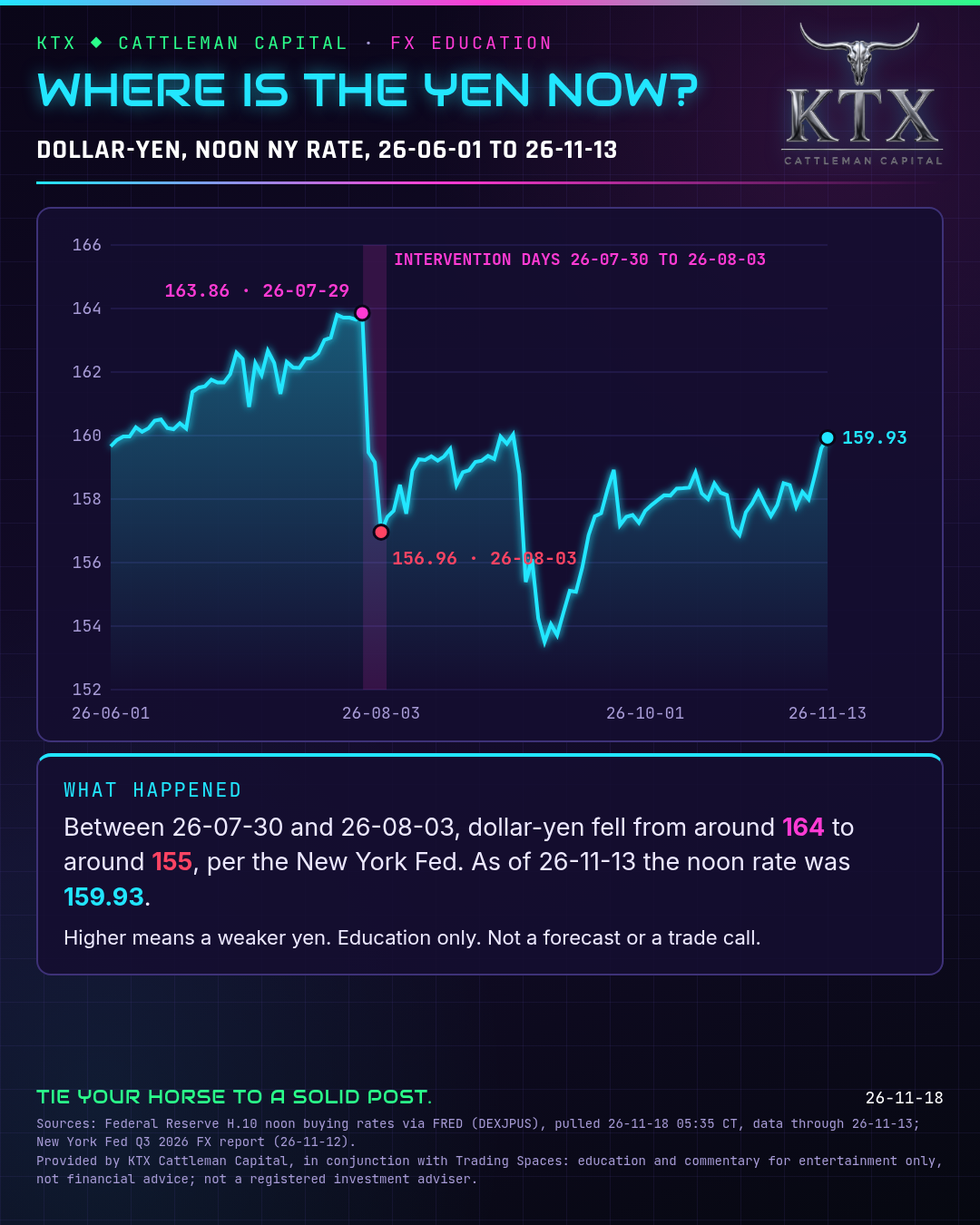
Between 26-07-30 and 26-08-03, dollar-yen fell from around 164 to around 155 (New York Fed, 26-11-12). On the Fed’s noon rate series, dollar-yen printed 163.86 on 26-07-29, 156.96 on 26-08-03 and 153.50 on 26-09-09, its low since then. As of 26-11-13 it stood at 159.93 (Fed H.10 via FRED, pulled 26-11-18 05:35 CT). Over the third quarter the dollar fell 3.2% against the yen (New York Fed, 26-11-12). Higher numbers mean a weaker yen.
Why bond traders care
To buy yen, Japan sells dollars, and those dollars come out of its foreign reserves. Japan is the largest foreign holder of Treasuries, at $1,068.3 billion at the end of August 2026, down from $1,103.9 billion at the end of July (U.S. Treasury TIC, Major Foreign Holders, read 26-11-18). TIC counts all holders in Japan, public and private, and does not say who sold or why.
There is a way to raise dollars without selling. The Fed’s FIMA Repo Facility lets central banks and other official holders with accounts at the New York Fed swap Treasuries for dollars temporarily through a repurchase agreement. The Fed calls it “an alternative temporary source of U.S. dollars for foreign official holders of Treasury securities other than sales of the securities in the open market.” It has been a standing facility since 21-07-28 (Federal Reserve, read 26-11-18).
The ledger after the trade
The Exchange Stabilization Fund’s euro holdings fell from $13.1 billion to $12.6 billion over the third quarter, while its yen holdings rose from $5.8 billion to $6.5 billion. The New York Fed says the change mostly reflects the 26-07-31 purchase. As of 26-09-30 the fund held $19.1 billion of foreign currency assets (New York Fed, 26-11-12).
How to read it
Opinion: intervention can slow a currency move and buy time. The receipts show who carried the load: Tokyo. The Fed kept its own balance sheet out of it, which our 26-10-07 Executive Brief flagged from the September FOMC minutes. Three public data points to watch: Japan’s monthly intervention totals, Japan’s Treasury holdings in TIC, and any use of the FIMA facility. This is education, not a forecast or a trade call.
Figures: Japan Ministry of Finance (26-11-09); New York Fed quarterly FX reports (Q3 2026, 26-11-12); Fed H.10 via FRED (through 26-11-13); U.S. Treasury TIC (through 26-08); Federal Reserve FIMA Repo Facility. All read 26-11-18 about 05:35 CT.
Preparation meets opportunity. KTX Cattleman Capital was built for this moment.
Tie Your Horse to a Solid Post.
Sources
- https://www.mof.go.jp/english/policy/international_policy/reference/feio/quarter/2026_3Qe.html
- https://www.newyorkfed.org/markets/quar_reports
- https://fred.stlouisfed.org/series/DEXJPUS
- https://ticdata.treasury.gov/resource-center/data-chart-center/tic/Documents/slt_table5.txt
- https://www.federalreserve.gov/monetarypolicy/fima-repo-facility.htm
On Trading Spaces
Week in Review and deeper dives
Full editions, the Friday Week in Review and longer deep dives publish first on the KTX channel, for Trading Spaces members.
Trading Spaces is a separate community with its own terms and privacy policy.
Provided by KTX Cattleman Capital, in conjunction with Trading Spaces. Commentary for entertainment only. Not financial advice.