KTX ◆ Cattleman Capital · Market Read
Strategy Is Not a Deck: What It Takes to Build One, and What It Takes to Win With It
Part 1 of the KTX Strategy Series. Strategies fail in two places: bad inputs at the start and thin support at the finish.
Jason Cox, Consulting Division, KTX Cattleman Capital · 26-11-18 · As of 26-11-18 6:50 AM CT
I have spent 25+ years selling and running commercial operations in cement, ready-mix, aggregates and construction materials. I have sat through a lot of strategy meetings. The room is rarely the problem, and the plan on the screen is usually decent. What decides the outcome is who built it, what data went into it, and whether the people who have to carry it out got what they needed on Monday morning.
This is Part 1 of a series on strategy. I split the work into two halves: building the strategy, and executing it. In my opinion, most companies put their attention on the first half and assume the second will take care of itself. That is where good strategies die.
Part One: Building the Strategy
Three things have to be in place before anyone writes a slide.
An Experienced Industry Operator Holds the Pen
A strategy for a heavy materials business has to be written by someone who has lived in it. Someone who knows why a customer with a perfectly good credit file still will not switch suppliers, what a dispatcher can and cannot do on a hot Tuesday, and which cost lines move and which only look like they move. A generalist can organize the work. An operator can tell you which parts of it are fiction.
This is the first place KTX earns its keep. The people who build our strategies have run sales and operations in this industry for decades, and I bring 25+ years of that experience to every engagement.
Accurate Data Comes Before Opinion
Good strategy starts with numbers you can defend in front of a CFO, a lender or a skeptical plant manager. That means knowing where each number came from and when it was pulled. If a figure cannot be sourced, it gets labeled as an assumption or it gets cut.
For national U.S. and Canada demand, we track the large-project build-out on the KTX Data Center & Space Race Map: https://www.ktxcattlemancapital.com/resources/mega-build-radar/.
Creative, Field-Tested Thinking Finds the Gap
Data tells you where the market is. Creativity tells you where it is being underserved. The best strategies I have seen did not beat the competition at its own game. They found a customer the competition was structurally poorly set up to serve, then built the offer around that customer.
The visuals below come from a KTX mock strategy I built for a fictional Gulf Coast cement importer, Lone Star Cement. It is my own work, not a client engagement. I left the dollar, volume and market-size figures out on purpose. The structure is what carries over to real engagements.
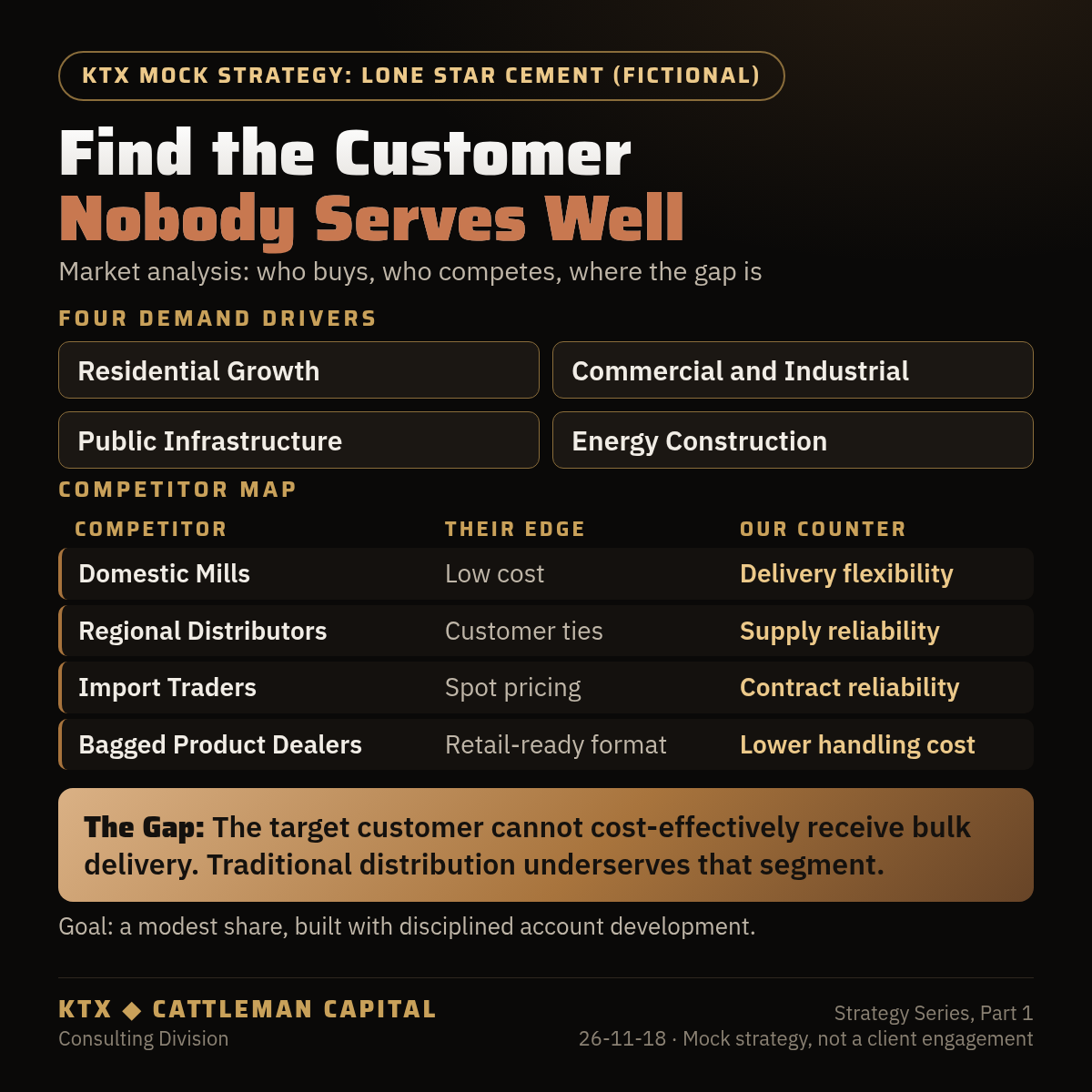
Market analysis map from the KTX mock strategy: four demand drivers, a competitor map, and the gap of customers who cannot receive bulk delivery.
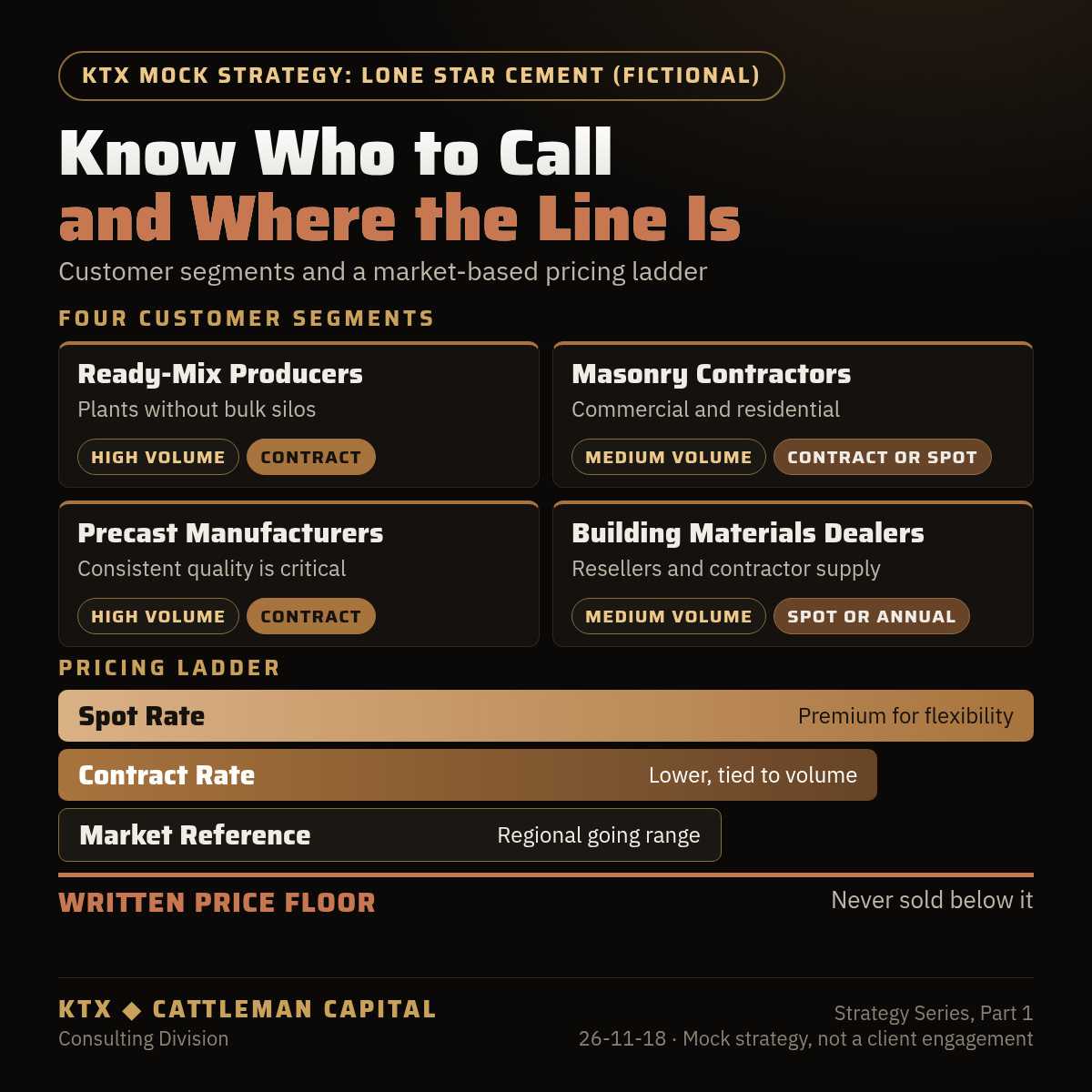
Four customer segments with contract versus spot pricing and a written price floor, from the KTX mock strategy.
Part Two: Executing the Strategy
A strategy that is built well and starved of support is still a failed strategy. Execution is a different job, and it belongs to the executive team.
Executive Support for Resources
The C-Suite has to put resources behind the plan, and I mean the real ones:
- Workforce. The right people in the right seats, hired before the plan needs them, not after the first miss.
- Operationally sound assets. Plants, trucks, terminals and equipment that can actually deliver what sales is about to promise.
- High quality product. Sales can only sell what operations can make or move to spec, every load, every time.
- Scalability. If the plan works, can the operation carry twice the volume without breaking? If the answer is no, the success of the strategy becomes its own risk.
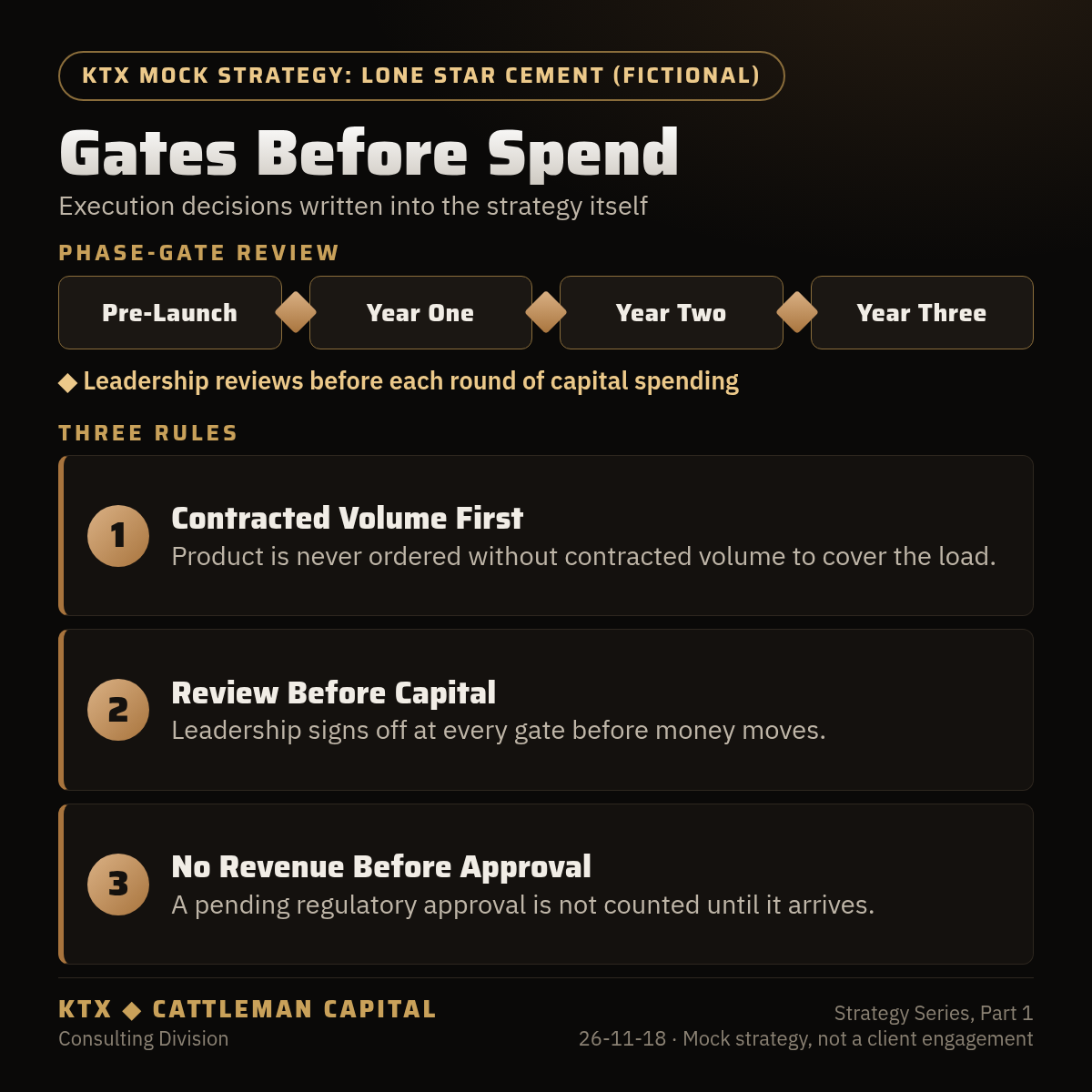
Phase gates and three execution rules from the KTX mock strategy: contracted volume first, review before capital, no revenue before approval.
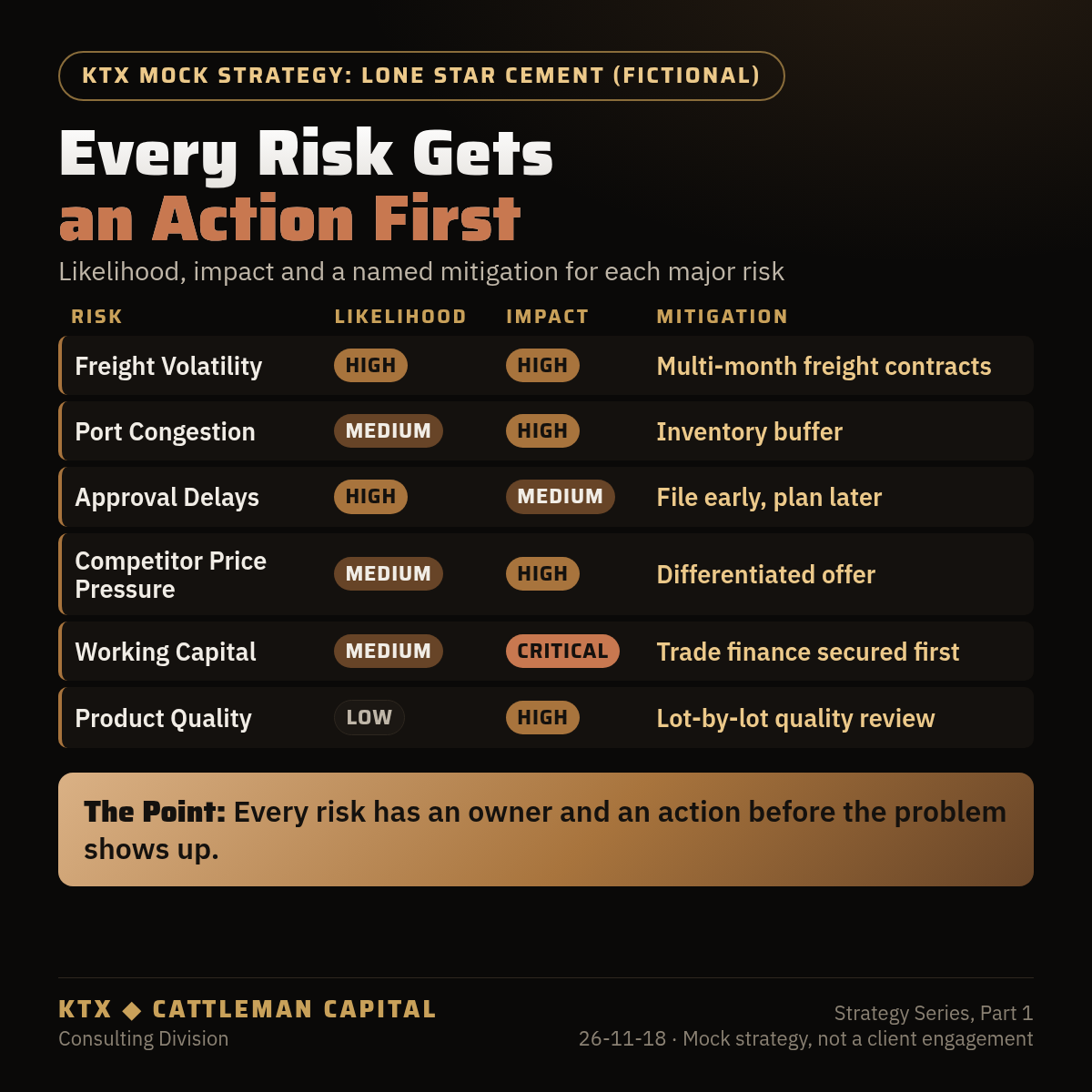
Risk table from the KTX mock strategy showing likelihood, impact and a named mitigation for each major risk.
Trust in the Tip of the Spear
This is the part that gets left out of most strategy articles. The C-Suite has to trust the managers at the tip of the spear: the sales manager, the operations manager, the regional leads. They are the ones who talk to customers, who see the plant floor and who know when the plan and reality have parted ways.
If executives do not trust that team, they micromanage, second guess and pull resources at the first soft month. If the managers do not feel trusted, they stop reporting bad news early, and bad news is the only kind you can still fix. In my opinion, trust is the cheapest resource a leadership team has, and the one most often spent carelessly.
Trust has to be earned in both directions. Build the team with care, give it clear targets and gates, then let it run.
Partner With the KTX Cattleman Capital Consulting Division
KTX Cattleman Capital does not come at your business like a software vendor that has never stood on a jobsite. We bring 25+ years of executive commercial, sales and operating leadership in cement, ready-mix, aggregates, precast and SCMs, and we use it to build corporate level sales and marketing strategies that are meant to add profit to your bottom line. No strategy can guarantee a result, but a well built one that is well supported gives you much better odds.
- Strategy Build. Market analysis, competitor mapping, customer segmentation, pricing logic and a phased go-to-market plan, built with your data and your people.
- Execution Readiness Review. We test whether your workforce, assets, product quality and capacity can carry the plan, and we show leadership where the gaps are before they cost you.
- Leadership Alignment. We help the C-Suite and the frontline management team agree on targets, gates and decision rights so trust is built into the plan.
If you want a strategy that your team can build and your executives can back, send me a direct message, or connect with the KTX Cattleman Capital Consulting Division to set up a confidential diagnostic conversation.
Next in the series (Part 2): Where the Data Comes From, and How to Tell When It Is Lying to You.
Tie Your Horse to a Solid Post.
Sources
If a decision on your desk needs clearer context, send me a message.
Get the Cement & Concrete Week in Review by email: sourced reads for building materials producers in the U.S. and Canada. Subscribe on Substack
Jason Cox · Founder & Principal · Katy, Texas